

How Much Amperage Does A Typical Electric Water Heater Draw
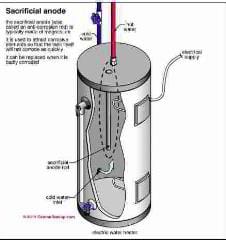 Hot H2o Heater Selection, Inspection, Installation, Diagnosis, & Repair Guide
- POST a QUESTION or Comment well-nigh diagnosing & repairing hot water heaters.
InspectAPedia tolerates no conflicts of interest. Nosotros have no relationship with advertisers, products, or services discussed at this website.
Water heater inspection, diagnosis and repair home page.
Guide to inspecting & fixing electric, gas or oil fired hot water heaters. Guide to tankless coils, indirect fired water heaters, range boilers. No Hot h2o? how to become more hot h2o menses, quantity, performance from your h2o heater.
Water heater synonyms: geyser (non-drinkable water), calorifier (potable water). H2o heater tank synonyms: hot water tank, water heater tank, calorifier tank, geyser tank, water kettle, h2o cauldron, water pot, water copper, domestic hot water.
This page contains links to in-depth articles on inspecting, testing, and repairing problems residential hot h2o heaters of all types, including their parts, controls, and alternative sources for hot water as well as tips for improving hot water temperature, hot water pressure level, and hot water quantity.
Manufactures listed here volition respond but nearly any question near domestic water heaters, water heater option, installation, trouble diagnosis, repair, operating price, or functioning. Folio acme sketch provided courtesy of Carson Dunlop Associates.
Nosotros besides provide an Article Alphabetize for this topic, or you can try the page top or bottom SEARCH BOX as a quick mode to observe information you demand.
Water Heater Inspection, Installation, Diagnosis, & Repair Guide
 While an electrical, gas-fired, or oil-fired h2o heaters, along with tankless coils on heating boilers are amid the most common methods for producing domestic or residential hot water for washing and bathing, in that location are plenty of other ways that people obtain hot water.
All hot water supply systems utilise some energy source (electricity, oil, gas, solar energy) to oestrus either a reservoir of hot water stored in a hot water tank, or to heat water as information technology is used (such equally tankless coils and Thermar™ type instantaneous water heaters.)
An exception is geo-thermal hot h2o (such as is readily available in Republic of iceland and in more localized areas in other countries). And the virtually common hot h2o complaint we hear is "how can I get more hot water quantity - I keep running out of hot h2o" or "how can I get improve hot water pressure?"
Our photo shows clear evidence of flue gas spillage from a gas fired water heater. In articles linked from this page we talk over this and other water heater diagnosis and repair topics.
The manufactures listed below describe the inspection, operation, diagnosis, repair, and improvement of each type of h2o heater, and nosotros include detailed advice about how to improve hot water supply in buildings equally well as inspection and correction of leaks, loftier hot water costs, odors, noises, and safety issues.
Note that in some parts of the world, such every bit Southward Africa, folks utilize the term geyser for water heater or hot h2o maker.
- Hot h2o problems and diagnostic guides for all kinds of hot water troubles are summarized at HOT WATER PROBLEM DIAGNOSIS.
- For bereft quantity of hot water or water that is non hot enough too see HOT WATER IMPROVEMENTS. You might want to check there to be sure you're fixing the correct problem.
Mutual Water Heater Problems
Not Enough Hot Water, or Water Not Hot Enough - what to practise nigh it
This is the most frequent question people enquire near hot h2o heating systems. See these detailed hot water diagnosis and repair or improvement articles:
- HOT WATER IMPROVEMENTS
- HOT WATER CIRCULATOR PUMP SPEEDS DELIVERY
- HOT Water EFFICIENCY IMPROVEMENT
- HOT WATER PRESSURE IMPROVEMENT
- HOT Water Pressure LOSS
- HOT H2o QUANTITY IMPROVEMENT
- Water HEATER TEMPERATURE TOO Low
Water Heater Basics: Types, Properties, & Inspection Topics for Home Water Heaters
Please encounter the manufactures listed at page top or at the More READING links at the bottom of this article under HOT Water HEATERS for our consummate listing of h2o heater articles.
Have you already checked our Hot Water Trouble Diagnostic Guide?
Earlier you commencement fixing or buying stuff to fix a hot water trouble hot water problems and diagnostic guides for all kinds of hot water troubles are summarized
at WATER HEATER Trouble DIAGNOSIS
. Yous might want to check at that place to be certain you're fixing the right problem. Those questions & suggestions tin can help point you to the shortest route to troubleshooting hot h2o complaints similar "no hot water" or "non enough hot water".
The following information virtually residential h2o heaters is adjusted, illustrated, and expanded from the Carson Dunlop Home Reference Book, with generous permission of Carson Dunlop Assembly.
Domestic water heaters provide hot water to the faucets and appliances. Near water heaters are conventional storage-type heaters, where heated water is stored in a large tank
. There are also tankless systems, where water is heated on demand, either past a boiler, or a dedicated water heater. Indirect water heaters are a tertiary blazon. They typically have a big tank, with the rut being provided by the banality that heats the house.
H2o may be heated past gas, propane, oil or electricity. Solar h2o heaters are also bachelor.
Water heaters may be used to estrus all, or part of a house, through the use of fan-gyre units, or radiant heating. This is called a combination heating organisation because the water heater provides domestic hot water and it heats the home.
The text below discusses residential electrical, gas, and oil fired water heaters and tankless h2o heaters. Also see
Alternative HOT WATER SOURCES.
What Are the Properties of Conventional H2o Heaters? Gas, Oil, Electric Water Heaters
Whether heated by gas, propane, oil or electricity, all conventional water heaters work the same way. Cold water enters the tank, and heated water leaves the tank. The heated water temperature is typically 120 to 140° F.
When a fixture runs hot water, the heated water leaves the tank and cold water enters, triggering the thermostat and turning on the burner or element. If heated h2o flows out faster than the incoming cool h2o tin can be heated, we will run out of hot water.
The larger the tank, the longer it takes to run out of hot water. And the larger the h2o heater tank the greater
the H2o HEATER STANDBY LOSSES.
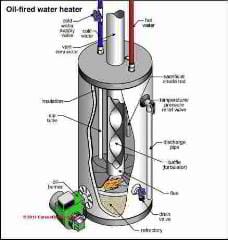
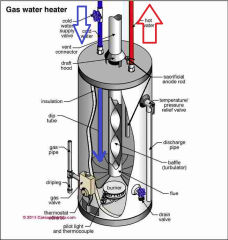
- Courtesy Carson Dunlop Associates, used with permission
How Large Should My H2o Heater Exist - What Size?
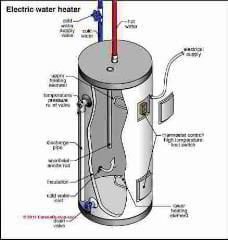
Water heaters should be big enough to satisfy the needs of the house. A family of four volition often find a 30-gallon gas or oil system or a xl-gallon electric organisation satisfactory.
Electric h2o heater cartoon (left) courtesy Carson Dunlop Associates, used with permission
Details near water heater size, hot water heating capacities or backdrop, recovery rates, h2o heater sizes, are in articles listed beginning
- WATER HEATER Problem DIAGNOSIS
- Water HEATER COMPARISONS, PROPERTIES
If y'all do not have enough hot water quantity, that is if you run out of hot water, or the hot h2o is non hot enough, run across these diagnosis and repair articles:
- HOT Water IMPROVEMENTS - how to get more than or hotter hot water in buildings
- HOT WATER CIRCULATOR PUMP SPEEDS Commitment - how to get hot water faster
- HOT WATER Pressure level EXPANSION RATE - how much does water expand when heated, what are the safety concerns with hot water expansion?
- HOT Water PRESSURE LOSS - how to diagnose and cure reduced or as well weak hot h2o pressure or flow charge per unit
- HOT H2o QUANTITY IMPROVEMENT - not enough hot water quantity? Read these articles
What is H2o Heater Recovery Rate?
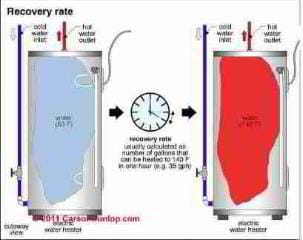
When the hot water is depleted, that is, when you are running hot water long enough that yous run out of hot water, the recovery rate becomes of import.
H2o heater recovery charge per unit cartoon (left) courtesy Carson Dunlop Associates, used with permission
Generally speaking, oil fired hot water heating has the fastest rate of recovery, with gas fired water heaters and electrical water heaters 3rd. If water is fatigued off slowly, the recovery rate may be such that the tank tin exist kept filled with hot water.
Faster h2o heater recovery rates let more water to be drawn off without running out of hot water.
Should I Insulate My H2o Heater?
Modern water heater tanks are insulated to slow the heat loss from the tank. Free energy-efficient tanks have better insulation. Some people as well insulate their hot water piping.
But y'all should not add together h2o heater insulation yourself without starting time reading the installation manual for your h2o heater. Y'all may brand the h2o heater unsafe and/or you may void the h2o heater warranty.
Run into INSULATE HOT WATER PIPING
and INSULATE HOT H2o TANK? for details
Water Heater Temperature Settings
Thermostats command the water temperature inside the water heater. In that location are some alien problems around appropriate h2o temperature. We don't want the water and so hot that it scalds people, but we want it hot enough to prevent bacteria similar Legionnaires illness from growing in the water heater.
Too, dishwasher manufacturers often recommend that the h2o be 140° F, since some dishwashing detergents will not dissolve completely at lower temperatures.
Many dishwashers accept internal heaters to bring cooler water upwardly to appropriate temperatures for washing dishes.
See Water HEATER SAFETY for details.
Anti-Scald Valves and Mixing Valves at Water Heaters
Some jurisdictions require tempering valves on water heaters, so h2o in the tank is at 140°, but as it leaves the tank, common cold water is mixed in to deliver 115° to 120° water. These tempering valves may be installed at the water heater, or at individual fixtures.
Details are at ANTI SCALD VALVES
Water Heater Fuel Problems: Oil, Gas, Electric
Malfunctioning burners, electrical elements, sensors or controls volition cause poor functioning or may result in the system non working at all, meaning no hot water. Run into our dissever articles on electrical water heaters, gas water heaters, and oil fired h2o heaters for details.
Also see the Home Reference Book Heating affiliate for more information about fuel systems, burners and electric elements.
H2o Heater Exhaust Venting Problems for gas or oil fired hot h2o heating systems
[Illustration: Vent Connector Length for a Water Heater]
To exist rubber and to work properly, most gas and oil water heaters accept to exist vented into a chimney with adequate draft. [An exception are electric water heaters and directly-vent water heaters.] Poorly bundled or disconnected vents are prophylactic hazards, which should be corrected promptly.
Aluminum vents are not permitted. Vent sections should exist as curt every bit possible, screwed together, and should slope up one/iv inch per pes, minimum. Vents should extend two feet above the roof and should exist two feet higher up anything within 10 anxiety horizontally.
Vents should extend at to the lowest degree v feet above the draft hood. Frazzle gases spilling out at the draft hood or burner may nowadays a life-threatening situation.
This trouble requires immediate action. Some modern gas water heaters employ induced draft fans and high-temperature plastic venting that discharges out through the business firm wall.
The vent materials were originally PVC, CPVC or ABS. In some areas these are replaced with special plastic vent pipes rated for the high frazzle gas temperatures.
Details are at GAS FIRED H2o HEATERS
and at OIL FIRED Water HEATERS
Water Heater Location
Gas or oil water heaters should not exist in sleeping areas. This is a safety consequence.
Gas-fired heaters in garages should exist 18 inches to a higher place flooring level to reduce the risk of the heater igniting gasoline fumes, and should be protected from mechanical impairment. Some jurisdictions call for electric heaters in garages to be similarly elevated.
Water Heater Noises
A snapping, hissing, crackling, or popping sound coming from the water heater tank when the heater is "on" may indicate a scale problem that is reducing hot water temperature, quantity, and water heater life.
See H2o HEATER NOISE DIAGNOSIS, CURE for details.
Why Bad Electric H2o Heater Elements Hateful Tepid Hot Water or Not Enough Hot H2o or No Hot Water
It is not unusual to find ane of the two elements in electric water heaters burned out. Replacing an element is not expensive. Most heaters are arranged and then that both elements cannot exist on at the same fourth dimension – the elements operate in a sequence.
Depending on which element fails, at that place may exist some hot water, or none.
Details are at ELECTRIC H2o HEATER ELEMENT TESTS
and
at ELECTRIC Water HEATER Element REPLACEMENT
Also encounter our complete article on electric water heater properties, inspection and diagnostic checklists, maintenance and repair procedures start at ELECTRIC Water HEATERS
Water Heater Leaks & Leak harm
Water heaters can, of course, leak, and the tanks can be mechanically damaged.
Details are at Water HEATER LEAK REPAIR
Sludge in the Water Heater
Where sludge has accumulated in the bottom of the tank, water pressure from the hot h2o organization may be limited.
When water force per unit area bug are experienced on the hot water system but, it makes sense to drain the water heater to ensure that sludge accumulation is not the trouble.
Some experts recommend draining i or two gallons out of the bottom of the tank monthly to forbid sludge build-up.
Water Heater Relief Valve Safety Warnings
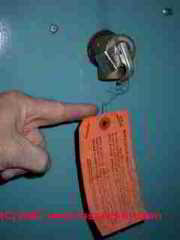
The temperature/pressure level relief (TP or TPR) valve lets water escape if the temperature or pressure is likewise high.
This valve should exist connected to a tube that discharges no more than vi inches above floor level so hot h2o is not sprayed on to anyone nearby. Some areas crave that the tube discharge outside the building.
The tube should be as large as the tank plumbing equipment and the tube finish should never be threaded, capped or plugged.
The tube diameter should be at least as large as the TPR valve plumbing equipment. The tube should be able to withstand 250°F temperatures, should have no close-off valve, and should be as short and as straight as possible.
An alternative to the high temperature role of the relief valve is a loftier temperature shutoff in the tank.
See RELIEF VALVE, WATER HEATER for details.
Water Heater Historic period: When is the H2o Heater Near Cease of Life?
Typical water heater life expectancy is ten-12 years, though in that location are exceptions with heaters that last a shorter period and others that we sometimes find terminal much longer.
The life that your water heater manufacturer expects for the unit is reflected in the water heater warranty period.
Details are at H2o HEATER LIFE EXPECTANCY COMPARISONS
Water Heater Installation Hookup: Piping Arrangements: single, serial, parallel installations
Details about water heater piping are
at H2o HEATER PIPING - cascaded, ganged, in series, in parallel
Reader Question: in a parallel water heater hookup do both heaters work at once?
My boyfriend is a long fourth dimension plumber in a modest town here in Northern Calif. He wanted me to look up Parallel plumbing on ii water heaters for opening a new bar. I found ii sites with the same hookup Cold h2o to Common cold Water and Hot to HoT on cold water.
He took the diagram and all the wholesalers in The Chico calif. were perplexed as to why this was shown this way.
Is this a error? Or is there an advantage to taking h2o from bottom of tank.
Does this piece of work both at same fourth dimension or just 1 at a time. I institute this to be a challenge to come across if this was something very ingenious and would like to make certain and sympathise and share that maybe y'all are getting more hot water this way or it's a mistake is labeling.
Note: see how the cold and hot are hooked up. Thanks for your time in this thing, my swain hooked upward the units as e'er only, my question wants to see if this is more efficient in a bar setting needing more hot water. - C.B. 8/5/2013
Reply: Piping Connections for Individual & Ganged Water Heater
I'chiliad not sure I have a articulate picture of the question only it seems to me that
1. For all conventional vertical reservoir-blazon tank-type water heaters, we always take hot water from water that is virtually the superlative of the tank interior ( hot water rises to the pinnacle of the tank interior regardless of how the water is existence heated; common cold water flowing into the tank to be then heated is delivered to the tank lesser) when delivering hot h2o to the building
2. There are very different reasons for hooking upwards multiple water heaters in series versus in parallel equally I outline merely below
Hooking Up Water Heaters in Serial - cascaded water heaters to handle varying demand
In series hookups the hot water out of heater 1 is taken into the cold inlet of heater 2 and the hot water outlet of heater #2 then feeds the edifice.
This approach is frequently used for both heating and hot water heating in big buildings and is sometimes called a cascade approach; with proper heater command settings it allows very economical heater operation - we but run one smaller heater when demand is low, only nosotros tin can run two or more heaters when demand is greater;
In a cascade organization the heaters downstream from the outset i act as boosters and plow on only as needed.
A variation of the cascade arroyo is to install a elementary water storage tank indoors ahead of the heater; water in the storage tank absorbs heat from the ambient indoor environment earlier feeding the h2o heater - reducing the heater'southward workload.
Hooking Up Water Heaters in Parallel - Case one parallel h2o heaters provide private building surface area hot water OR Example 2 parallel water heater hookups provide loftier constant hot water output volume to a unmarried user
Parallel water heater hookups (Which I think you lot are describing) basically are feeding cold water in parallel to multiple h2o heaters (i.eastward. simultaneously) and the output from each of the heaters (the hot out) feeds either dissimilar edifice areas, apartments, or users (case Parallel 1) ,
or feeds a manifold that so joins the output from all of the heaters to feed a single hot h2o line feeding a large building (case Parallel 2).
Parallel 1 is what we would look to encounter in a small apartment building or multifamily house - essentially each tenant has their own water heater - cold water in merely private hot water out is fed to each tenant or flat or building surface area. This arroyo is economical and allows each tenant to be charged for their individual water heater use (if metering is installed).
Parallel 2, which I've heard-of only never seen and which I recollect has less awarding, is in my OPINON an inefficient variation on the cascade water heater approach designed to requite a high hot water output quantity to a single destination.
Watch out: keep in mind that there is good reason that the incoming common cold h2o must be connected to the "Cold" marked inlet on the water heater, as the manufacturer specifies - a dip tube is delivering cold water to the heater tank bottom. Hooking upwards a water heater backwards gives bad results.
For your swain'due south example, hooking up hot h2o supply for a bar, to decide how to hook upward his two water heaters depends on what problem he's solving. if the problem is adequate total hot h2o quantity when hot h2o demands vary significantly over fourth dimension then he'd want to apply the cascade approach - hook up the heaters in series.
If for some reason he has no room for a larger capacity single water heater merely needs a large quantity of hot water always bachelor and so a parallel hookup (Parallel hookup instance 1 to a higher place) might be usable.
Yous didn't say what energy source these heaters utilise - I'chiliad guessing they are electrical, merely the parallel / serial hookup question and answer remains the same for all energy sources. At the end of the day I wonder if nosotros were not a chip dislocated nigh "parallel" vs "series" hookups of hot water sources. If I've misunderstood your state of affairs or question please let me know.
Watch out: your boyfriend, being a plumber, will doubtless confirm some other little installation detail that nosotros mention for other readers: the water heater shutoff valve should be only on the cold inlet side of the heater. A shutoff valve on the outgoing hot side of the heater - correct at the heater, invites a disaster.
See BLEVE EXPLOSIONS .
Now what happens if we claw upward 2 or more than water heaters in series? The hot out of heater
1 enters the cold inlet to heater
two. But I would not install a shutoff betwixt the ii h2o heaters - doing so creates the same unsafe condition.
What does the plumber say about shutoff valve locations on a multi-heater installation in series?
Water Tank Piping Connections & Number of Pipes Can Identify the Original Use of Storage Tanks
- One or two piping connections: an cranium expansion tank may have just two pipe connections, one feeding heating h2o from a hot water heating organisation into the expansion tank and a second providing overflow drainage.
- Two or three pipage connections: An cranium cistern typically has an inlet pipe supplying h2o to the cistern, sometimes from roof drainage, and an outlet pipe supplying water to the building, and an overflow pipe should the cistern otherwise exist discipline to over-filling and spillage.
- Four pipe connections: a range boiler typically has four pipe connections: two circulating water through the heating boiler heat exchanger or a side-arm coil to oestrus the h2o in the tank and a cold water inlet from the building water supply forth with a hot h2o outlet supplying building water fixtures.
The range banality and any other water storage tank that operates under pressure should as well have a relief valve that in plow may as well be connected to a discharge tube to prevent scalding a bystander.
- Four or five pipe connections: a h2o heater and hot water storage tank designed every bit a solar water heater or range banality will typically have four piping connections:
two lines run to and from the water heating source, possibly circulating by convection with cold water leaving the tank lesser and warm or hot h2o entering higher on the tank;
two other lines will feed cold water supply into the storage tank and hot water out of the storage tank headed for building plumbing fixtures.
A 5th pipage may provide an overflow drain
- Too encounter IDENTIFY WATER TANK USE - aid in identifying all types of water heaters including antique water heating methods.
- Also see TANK TYPES: EXPANSION, OIL, SEPTIC WATER, ALL
H2o Heater Maintenance Procedures
Proper water heater maintenance - such as draining sludge out of the tank or removing lime and calibration tin can significantly increase water heater life. Meet these water heater maintenance manufactures:
- To drain your water heater tank, for case to replace a part,
see H2o HEATER DRAIN PROCEDURE.
- To affluent accumulated grime or debris from a h2o heater (yearly maintenance)
see Water HEATER Affluent Procedure
- To de-scale or de-lime your hot water heater,
run across WATER HEATER Scale DE-LIMING Procedure
- To diagnose and repair a bad h2o heater dip tube or anode,
see Water HEATER ANODES, DIP TUBES
- To diagnose particulate debris in the building water supply, faucet strainers, etc. that comes from the hot water tank, and how to fix that trouble,
meet H2o HEATER Debris Flush
Tankless Water Heaters: Properties of, Common Problems With
Details about tankless h2o heaters are found
at TANKLESS Water HEATERS. Tankless water heater basics are given just below.
As the name suggests, tankless water heaters take no storage capacity. Tankless heaters are typically gas or propane fired and take a burner, heat exchanger, venting system, and controls.
When the faucets and fixtures in the home are idle, the water heater is dormant. When there is a call for hot water, the heater detects the water flow and ignites the burners.
These powerful burners speedily heat the water inside the small oestrus exchanger. Every bit hot h2o leaves, fresh cold h2o is drawn in and heated as it passes through. An advantage of this organisation is that you lot can't empty all of the hot water out of the tank because at that place is no tank – just continuous hot water.
Tankless Water Heaters do not "Store Hot Water"
The other major reward over conventional water heaters is free energy savings. Tankless water Water heaters take no reservoir of hot h2o sitting idle. It takes energy to keep the tank of water hot all the time for when information technology's needed.
Small Size of Tankless Heaters
Tankless water heaters are much smaller than conventional heaters with storage tanks, and are unremarkably wall-mounted. They exercise not take upwardly much infinite.
Tankless water hater fuel and combustion gas venting
Most tankless water heaters are fueled by natural gas or propane and are vented through a side wall of the business firm.
Efficiency of Tankless Water Heaters
Tankless water heaters are often more efficient than conventional water heaters, using modulating burners, direct venting and/or condensing combustion systems.
Tankless water heaters accept zippo standby losses - increasing their efficiency in comparing with tank blazon water heaters and thus reducing hot h2o costs.
Mixing Valves on Tankless Water Heaters - Anti Scald Devices
About systems include a mixing (tempering) valve and a means of setting a maximum water temperature to avert scalding. This tempering valve mixes some cold water with the hot water leaving the unit to reduce the temperature.
Remote Controls on Tankless Water Heaters
Some tankless systems include a remote control, which can be used to monitor the performance of the arrangement, display error codes or change the desired water temperature.
Other Uses of Tankless H2o Heaters
Tankless water heaters may also be used to heat the home, either as part of a forced air combination organization, or a radiant hot water system.
Lookout Out: The duty bike of a conventional water heater or even a tankless water heater may non support home heating applications.
See WATER HEATERS for Dwelling HEATING Utilize? for some warnings about using water heaters for conventional heating.
Common Tankless Water Heater Issues
Fuel Supply Troubles
The water heater must have a continuous fuel supply. Malfunctioning burners, sensors or controls volition cause poor operation or may result in the system not working at all, meaning no hot water.
Calibration Build-upwardly
The pocket-sized diameter of the heat exchangers means that these units are susceptible to clogging with scale, particularly in areas with hard h2o. In difficult h2o areas, annual de-scaling is recommended.
Longer Wait Times
When a hot h2o faucet is turned on, information technology may take longer to become hot water with a tankless heater than a conventional system.
The delay between opening the faucet and getting hot water tin can exist longer with tankless heaters than conventional tank heaters. Better tank locations and multiple tanks can help with consequence.
Maximum Catamenia Rate for Tankless Water Heaters
The hot water period rate is not merely dependent on the heating capacity of the h2o heater and the output h2o temperature, but besides on the inlet water temperature.
Homes in northern climates draw water from colder sources, and since it takes longer to rut upward colder h2o, tankless water heaters installed in these homes take lower hot water flow rates.
Minimum Menstruum Rate for Tankless H2o Heaters
The burners are triggered by sensors that detect the flow of water. If the menstruation rate is less than 1/2 gallon per minute, the burners may not plow on and no hot water will be delivered.
H2o-saving shower heads, for example, may not flow enough to plow the water heater on, specially if the water heater needs a high flow charge per unit before information technology will come on.
Tankless Water Heater Temperature & Force per unit area Safety Relief Valves
The temperature/pressure level relief (TPR) valve lets h2o escape if the temperature or pressure is too high. This valve should be continued to a tube that discharges no more than half-dozen inches above floor level so hot water won't scald anyone nearby. Some codes require that the tube belch outside the building.
The tube should be every bit big equally the tank fitting and the tube end should never exist threaded, capped or plugged. The tube should be able to withstand 250°F temperatures, should take no shut-off valve, and should be as brusk and equally straight as possible.
High Cost for Tankless Water Heaters
Tankless h2o heaters are considerably more than expensive than conventional tank-type heaters, and although tankless units are more energy efficient, it may have a long time to recover the actress investment.
High Maintenance for Tankless Water Heaters
Conventional h2o heaters are relatively inexpensive due to their simplicity. Tankless water heaters are more expensive and more than complex.
Their complexity also means that maintenance and repairs can be more expensive. Isolating valves help simplify draining and other regular maintenance.
Dirty Water Filter on Tankless H2o Heaters
If the heater is equipped with a water filter, this should be checked and cleaned monthly, or operation will suffer.
Details about Tankless Water Heaters
Run across our article series on tankless h2o heaters or instant h2o heaters, point of use water heaters, and demand h2o heaters beginning
at TANKLESS Water HEATERS
Portions of this fabric are: - Adapted from the Home Reference Book, courtesy of Carson Dunlop Associates.
Reader Comments & Q&A
Ruben I am not sure I understand the question. But I'm taking a stab at information technology anyhow.
Sentry out: from your photos I run into we're talking about a steam heating system.
Before making any pipe changes to steam pipe information technology is essential to understand exactly what pipes are doing what and how they must be routed.
For example: raising a condensate return piping to a steam system to get over a door will create a trap that stops the steam estrus from working at all.
In a two-pipe steam system i piping brings steam to the radiator and a second pipage drains condensate back to the banality.
In your photo, that bottom inlet to the radiator would ordinarily be a path for steam condensate to return to the boiler, but I'thousand dislocated past the prospect of trying to push steam DOWN into the radiator from its top end.
And then peradventure this is a basement radiator that'southward actually filled with hot condensate, radiating heat every bit condensate returns through it to the steam banality.
Sentry out: if that's the case you lot cannot simply remove and cap off pipes in and out of this radiator or yous'll turn off steam estrus to everybody above.
But you lot can eliminate the radiator and go simply to a continuous condensate render line to the boiler.
@Ruben, the return leads to this pipe and into grey piping. Tin I just cap the supply and return? Please assistance. Supply is direct from a principal T but only supports the heater in pic. Likewise render has water in it when I disconnect it
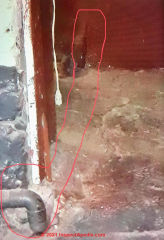
Good evening
I live in the basement of a edifice with 62 dwellings. My male parent in-police force put a heater for me that has to exist high up. But I want to eliminate it completely but don't know what to do I cut the piping only h2o is coming up the bottom pipe and h2o leaking through top rite pipage.
My question is can I cap off peak pipe that gets hot and lesser pipe or joined them together? Boiler is about 30 feet abroad.
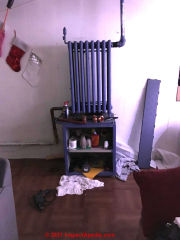
Dave
Help me please - we have millions of readers. Just post questions once on i folio
https://inspectapedia.com/aircond/Condensate_Pumps.php#FAQ
We have a tankless water heater where the condensate is routed to a sealed sump pit with a radon organisation. The air in the sump would be causing suction on the condensate line and thus the inside of the tankless water heater. Does anyone have thoughts on the appropriateness of this setup? Cheers in advance
Fran,
More than likely the water heater will stop working from rain, rust, corrosion, or freezing. It may also be unsafe.
My landlord moved the hot water tank from the cranium to make room for a heating and air unit now the hot water tank is outside volition this cause the hot h2o tank to excessively heat to water in the wintertime time
...
Continue reading at HOT H2o IMPROVEMENTS or select a topic from the closely-related articles below, or encounter the complete ARTICLE INDEX.
Or run across WATER HEATER FAQs - questions & answers nigh water calorifiers, geyers, cylinders, or water heaters posted originally at the end of this page.
Or see these
Recommended Articles
- WATER HEATERS - home
- Age of WATER HEATERS
- ANTI SCALD VALVES / MIXING VALVES
- Culling HOT Water SOURCES
- AQUASTAT CONTROLS - dwelling house
- Clogged PIPES / TANKLESS COIL DE-Scale
- Bleed a Water HEATER TANK
- ELECTRIC H2o HEATERS - home
- GAS FIRED WATER HEATERS
- HOT WATER IMPROVEMENTS - home
- HOT H2o Pressure LOSS
- INDIRECT FIRED H2o HEATERS
- NO HOT WATER Pressure level
- Racket, WATER HEATER
- ODORS IN WATER
- OIL FIRED H2o HEATERS
- RANGE BOILERS
- RELIEF VALVE, WATER HEATER
- SCALDING TEMPERATURES & TIMES
- SCALE REMOVAL, WATER HEATERS
- TANKLESS COILS
- TANKLESS H2o HEATERS
- WATER HEATER Age & MANUALS
- WATER HEATER EFFICIENCY
- WATER HEATER LEAK REPAIR
- H2o HEATER LIFE
- WATER HEATER LEAK REPAIR
Suggested commendation for this web folio
H2o HEATERS at InspectApedia.com - online encyclopedia of building & ecology inspection, testing, diagnosis, repair, & problem prevention communication.
Or see this
Index to RELATED Manufactures: Commodity INDEX to Water HEATERS
Or use the SEARCH BOX constitute below to Ask a Question or Search InspectApedia
...
Ask a Question or Search InspectApedia
Questions & answers or comments about diagnosing & repairing hot water heaters.
Endeavour the search box just below, or if you prefer, post a question or annotate in the Comments box below and we will respond promptly.
Search the InspectApedia website
Note: appearance of your Comment below may be delayed: if your comment contains an image, web link, or text that looks to the software every bit if information technology might be a spider web link, your posting will appear after it has been approved by a moderator. Apologies for the delay.
Technical Reviewers & References
Click to Prove or Hide Citations & References
Publisher InspectApedia.com - Daniel Friedman

Source: https://inspectapedia.com/plumbing/Hot_Water_Heater_Cylinder.php
Posted by: woodallmanower49.blogspot.com
0 Response to "How Much Amperage Does A Typical Electric Water Heater Draw"
Post a Comment